
IT Staff Augmentation in 2026: Global IT Market Trends & How to Scale Your Tech Team
Why IT staff augmentation matters in 2026
IT staff augmentation means adding vetted external engineers to your own team, under your own management, for as long as a project needs them. In 2026 it has become one of the fastest ways to close a skills gap. Technology budgets are growing much faster than the supply of people who can deliver the work.
Gartner expects worldwide IT spending to reach $6.37 trillion in 2026, up 14.2% from 2025. In the same year, 72% of employers report difficulty filling roles, according to ManpowerGroup’s survey of more than 39,000 employers. AI skills are now the hardest of all to find.
In short:
- IT budgets are at a record high, and most of the new money is going into AI, cloud and data infrastructure.
- The engineers needed to build these systems are scarce, especially in AI, data and cloud.
- IT staff augmentation lets you add specific skills in weeks without a permanent hire, while you keep control of the work.
This guide covers the 2026 IT market, how IT staff augmentation works, how it compares with outsourcing and in-house hiring, and how to choose a partner. It draws on data from Gartner, ManpowerGroup and Staffing Industry Analysts. It also draws on how Tech Solutions (techsolutions.ae) places engineers with clients in the US, UK and GCC.
The global IT market in 2026: bigger budgets, scarcer talent
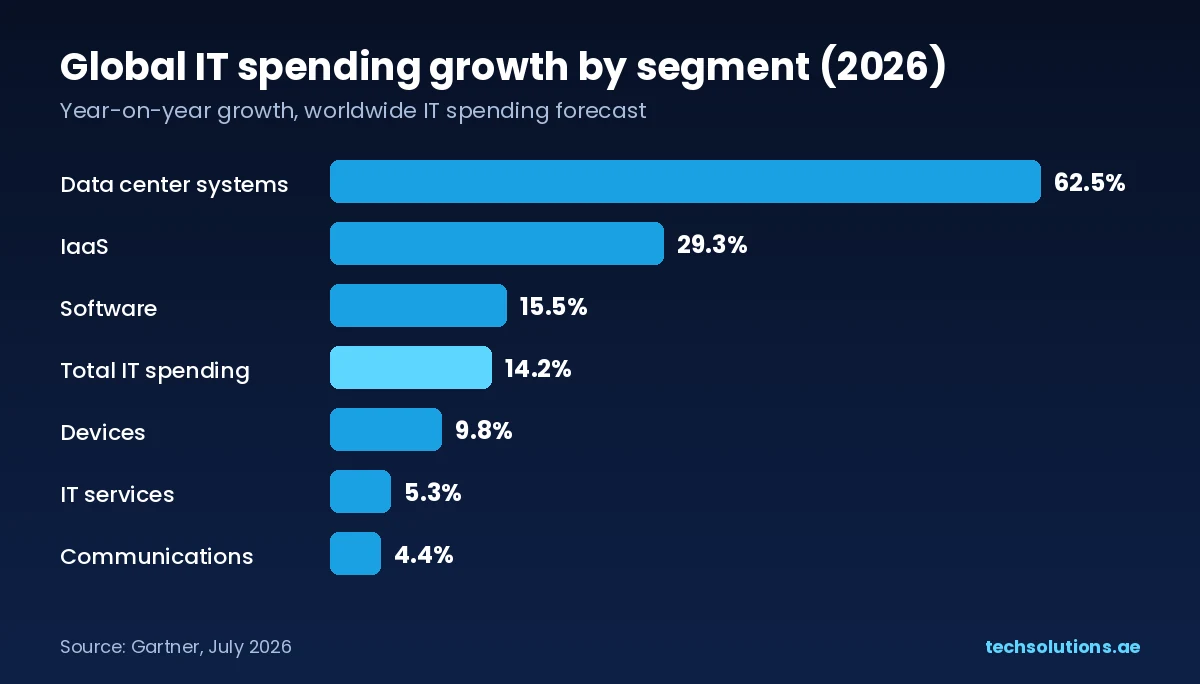
Worldwide IT spending is forecast at $6.37 trillion in 2026, up 14.2%. Most of the extra money is going into AI infrastructure, cloud and software. Gartner’s July 2026 forecast by segment:
| Segment | 2025 spending ($bn) | 2026 spending ($bn) | 2026 growth |
|---|---|---|---|
| Data center systems | 506 | 822 | 62.5% |
| Infrastructure as a Service (IaaS) | 222 | 287 | 29.3% |
| Software | 1,271 | 1,468 | 15.5% |
| Devices | 790 | 868 | 9.8% |
| IT services | 1,492 | 1,570 | 5.3% |
| Communications services | 1,296 | 1,354 | 4.4% |
| Total IT spending | 5,577 | 6,369 | 14.2% |
Gartner analyst John-David Lovelock described building AI compute as “the largest infrastructure project ever attempted by humanity.” Every data center, cloud platform and AI application in that budget needs engineers to design, build and run it.
The talent gap behind the numbers
The people who can do this work are in short supply. ManpowerGroup’s 2026 Talent Shortage Survey covered 39,063 employers in 41 countries, including the UAE, UK and US. It found:
- 72% of employers worldwide report difficulty filling roles. The rate is 73% in the UK, 69% in the US and 83% in Germany.
- AI skills are now the hardest to find for the first time. AI model and application development (20%) and AI literacy (19%) top the list, ahead of traditional IT and data skills (17%).
- The information industry has the highest shortage of any sector, at 75%.
- Employers are responding with more flexible models: 18% are targeting new talent pools and 18% are offering location flexibility.
Budgets for projects, caution on headcount
The staffing market is growing more slowly than IT budgets. Staffing Industry Analysts projects the US staffing market to grow 1% in 2026, to $180.2 billion. Many companies are funding AI and cloud projects with fixed end dates while staying cautious about permanent hires. IT staff augmentation fits that gap: it adds capacity for the length of a project.
A note on market-size figures: published estimates for the “IT staff augmentation market” range from a few billion dollars to over $400 billion. They measure different things, from pure staffing fees to all offshore development. When you plan a budget, use figures with a clear method and a named source.
What is IT staff augmentation and how does it work?
IT staff augmentation is a flexible staffing model. A partner supplies pre-vetted IT professionals who join your existing team and work under your direction. The partner handles sourcing, screening, contracts, payroll and compliance. You keep control of priorities, code, tools and delivery.
It differs from outsourcing in one important way. With outsourcing, you hand a defined project to a vendor and receive the result. With staff augmentation, you add people to your team and manage the work yourself.
How a typical engagement runs
- Define the gap. List the skills, seniority, time zone overlap and duration you need. Example: two senior React developers for six months, with four hours of overlap with London.
- Receive shortlisted profiles. The partner screens candidates for technical skills, communication and fit, then shares a short list.
- Interview and select. Your team runs its own technical interviews and chooses who joins.
- Onboard. The engineers get access to your tools, repositories and ceremonies, and join stand-ups like anyone else on the team.
- Manage and scale. You direct the day-to-day work. The partner handles admin and replacements, and adds or removes people as the project changes.
Common engagement models
- Contract staffing: engineers join for a fixed term, such as 3, 6 or 12 months.
- Contract-to-hire: you work with an engineer first and can convert them to a permanent employee later.
- Project-based staffing: a small group is added for one initiative, such as a cloud migration or an AI pilot.
- Dedicated team: a long-term pod of engineers works only on your product.
Partners also differ by location. Onshore talent is in your own country, nearshore talent is in a nearby time zone, and offshore talent is further away and usually costs less. Many US and UK companies now combine a local lead with offshore engineers who work part of their day in the client’s hours.
Staff augmentation vs outsourcing vs in-house hiring
Staff augmentation is the best fit when you have technical leadership in place and need specific skills quickly. Outsourcing suits a well-defined project you want delivered end to end. In-house hiring suits core, long-term roles.
| Factor | IT staff augmentation | Project outsourcing | In-house hiring |
|---|---|---|---|
| Who manages the work | You | The vendor | You |
| Typical time to start | Days to a few weeks | Weeks (scoping and contract) | Often 1–3 months (recruiting and notice periods) |
| Control over code and process | Full | Limited to the contract | Full |
| Cost structure | Monthly or hourly rate, no long-term overhead | Fixed price or milestone payments | Salary plus benefits, equipment, recruiting and taxes |
| Scaling up or down | Fast and flexible | Needs a contract change | Slow; layoffs are costly |
| Knowledge retention | Shared; needs documentation | Mostly stays with the vendor | Stays in the company |
| Best for | Skill gaps, tight deadlines, AI and cloud projects | Clearly scoped products or modules | Core product and leadership roles |
Many companies use all three. A typical setup keeps architecture and product ownership in-house, augments the team for delivery, and outsources standalone work such as a marketing site.
The most in-demand augmented IT roles in 2026
Demand is highest for the skills that 2026 budgets are paying for: AI, data, cloud and security. These are the roles companies most often augment:
| Role | Why demand is high in 2026 |
|---|---|
| AI / ML engineers and LLM application developers | AI model and application development is the hardest skill to find worldwide (ManpowerGroup, 2026) |
| Data engineers and analytics engineers | AI systems depend on clean, well-structured data pipelines |
| Cloud, DevOps and platform engineers | IaaS spending is growing 29.3% and data center spending 62.5% (Gartner, 2026) |
| Cybersecurity engineers | New AI systems and cloud workloads widen the attack surface |
| Full-stack and backend developers with AI tools | Teams want engineers who ship faster with AI-assisted coding |
| QA and test automation engineers | Faster release cycles need automated testing |
| CRM and enterprise platform specialists (Salesforce, Veeva, SAP) | Regulated industries such as pharma depend on specialist platform skills |
Senior and specialist roles are the hardest to fill. That is where augmentation saves the most time, because the right person may not exist in your local market.
Benefits, costs and risks of IT staff augmentation
The main benefit is speed: you get specific skills in weeks instead of months, without adding permanent headcount.
Key benefits
- Faster time to market: start a project when the budget is approved, not when the hiring finishes.
- Access to scarce skills: reach AI, cloud and security specialists beyond your local market.
- Flexible capacity: scale up for a launch and scale down afterwards.
- Lower overhead: the partner handles recruiting, payroll, equipment and compliance.
- Full control: your managers set priorities, and your code stays in your repositories.
How to compare the cost correctly
Don’t compare an augmentation rate with a salary. Compare it with the fully loaded cost of an employee. That includes salary, benefits, payroll taxes, equipment, office space, recruiting fees, and the time the role sits empty while you hire. Rates also depend on seniority, skill rarity, time zone overlap and engagement length. Specialist AI and security roles cost the most in every market.
Risks and how to manage them
| Risk | How to manage it |
|---|---|
| Knowledge leaves when the engagement ends | Require documentation, pair programming and a planned handover |
| Communication gaps across time zones | Agree on fixed overlap hours and a shared stand-up |
| Data security and IP | Sign NDAs and IP assignment clauses; use your own accounts and access controls |
| Poor fit with the team | Interview candidates yourself and agree on a free replacement period |
| Hidden costs | Get all-inclusive rates in writing, including notice periods and conversion fees |
How to choose an IT staff augmentation partner: 8-point checklist
The right partner shows you real engineers, clear terms and proof of past delivery before you sign. Ask every vendor these eight questions:
- Vetting: how are engineers tested for technical and communication skills? Can you see the test?
- Speed: how quickly can they share profiles for your exact stack, and how quickly can people start?
- Time zones: how many overlap hours with your team can they guarantee?
- Replacement: what happens if an engineer leaves or isn’t a good fit, and how fast is the replacement?
- Security and IP: do contracts include NDAs and IP assignment? Do engineers work in your own systems?
- Track record: do they have case studies or references from companies of your size and industry?
- Pricing: are rates all-inclusive? Are there fees for conversion, notice periods or early exit?
- Compliance: do they handle payroll, tax and employment law in the countries where the engineers are based?
A partner who answers all eight clearly and in writing is usually a safe choice.
How Tech Solutions delivers IT staff augmentation
Tech Solutions (techsolutions.ae) is an IT staff augmentation and software development company. It is headquartered in the Sharjah Research Technology and Innovation Park (SRTIP) Free Zone, UAE, with offices in the UK, the US and Pakistan. Clients in the US, UK and GCC use it to add pre-vetted engineers to their teams.
Tech Solutions engineers have worked with teams at QPharma, GSK, Regeneron, P&G, Nestlé and Ciklum, including in regulated pharma and life-sciences environments.
What you get:
- Engagement models: contract staffing, contract-to-hire, project-based staffing and dedicated teams.
- Skills: software and web development, cloud and DevOps, data, AI, QA and enterprise platforms.
- Time zone coverage: teams across the UAE and Pakistan, with working-hour overlap for UK, European and US clients.
- Compliance handled: sourcing, contracts, payroll and local employment rules.
- White-label delivery: agencies can resell Tech Solutions engineering under their own brand (White Label Partners).
Need to scale your tech team? Explore our IT staff augmentation services or share your job description to receive matched profiles.
Frequently asked questions about IT staff augmentation
What is IT staff augmentation?
IT staff augmentation is a staffing model where a partner provides pre-vetted IT professionals who join your in-house team on a temporary or long-term basis. You manage their daily work. The partner handles recruiting, contracts, payroll and compliance.
What is the difference between staff augmentation and outsourcing?
With staff augmentation, you add engineers to your own team and manage the work yourself. With outsourcing, you give a defined project to a vendor, which manages the team and delivers the result. Augmentation gives more control. Outsourcing gives less management work.
How fast can augmented engineers start?
Most partners share shortlisted profiles within days and can have engineers working within a few weeks. Hiring a permanent employee often takes one to three months once you include notice periods. Rare specialist roles may take longer either way.
Is IT staff augmentation cheaper than hiring?
It is often cheaper for short or medium-term needs. You avoid recruiting fees, benefits, equipment and long-term overhead. For roles you need permanently, in-house hiring can cost less over several years. Compare against the fully loaded cost of an employee, not just salary.
Which IT roles are hardest to hire in 2026?
AI skills are the hardest to find worldwide in 2026. AI model and application development and AI literacy lead ManpowerGroup’s 2026 ranking. Cloud, data and cybersecurity engineers are also in high demand as AI and cloud spending grows.
How do I protect my IP and data with augmented staff?
Use NDAs and IP assignment clauses in every contract. Give engineers access through your own accounts, with role-based permissions. Keep all code in your own repositories, and remove access as soon as the engagement ends.
Does Tech Solutions provide IT staff augmentation outside the UAE?
Yes. Tech Solutions (techsolutions.ae) is based in the Sharjah SRTIP Free Zone and serves clients in the US, UK, Europe and the GCC. Its engineers work with overlap hours that match each client’s time zone.
