
The AI Skills Gap: Why 72% of Employers Can’t Hire, and What to Do About It
What is the AI skills gap?
The AI skills gap is the difference between the AI skills companies need and the AI talent actually available to hire. In 2026 it is the biggest hiring problem in technology. For the first time, AI skills are the hardest skills to find anywhere in the world.
The numbers are stark. 72% of employers worldwide report difficulty filling roles, according to ManpowerGroup’s 2026 survey of more than 39,000 employers. In the UAE the figure is 76%. Meanwhile, PwC finds that jobs requiring AI skills grew 69%, while the overall job market grew just 9%.
In short:
- Demand for AI skills is growing several times faster than supply.
- Companies want senior AI engineers, and very few of them exist.
- The gap costs companies through delayed projects, lost productivity and rising salaries.
- The fastest fixes combine upskilling your current team with bringing in specialists through AI staff augmentation.
This article explains the data behind the AI skills gap, why it keeps growing, which roles are hardest to fill, and six practical ways to close it.
The AI skills gap in numbers (2026)
Three major 2026 studies point the same way: AI skills are the scarcest in the market, and the shortage is global.
AI skills are now the hardest to find
ManpowerGroup’s 2026 Talent Shortage Survey of 39,063 employers in 41 countries ranked the hardest skills to find:
| Rank | Skill | Employers reporting a shortage |
|---|---|---|
| 1 | AI model and application development | 20% |
| 2 | AI literacy | 19% |
| 3 | Engineering | 19% |
| 4 | Sales and marketing | 18% |
| 7 | Traditional IT and data skills | 17% |
In Asia Pacific and the Middle East the AI gap is even wider: 27% of employers cite AI model and application development and 26% cite AI literacy.
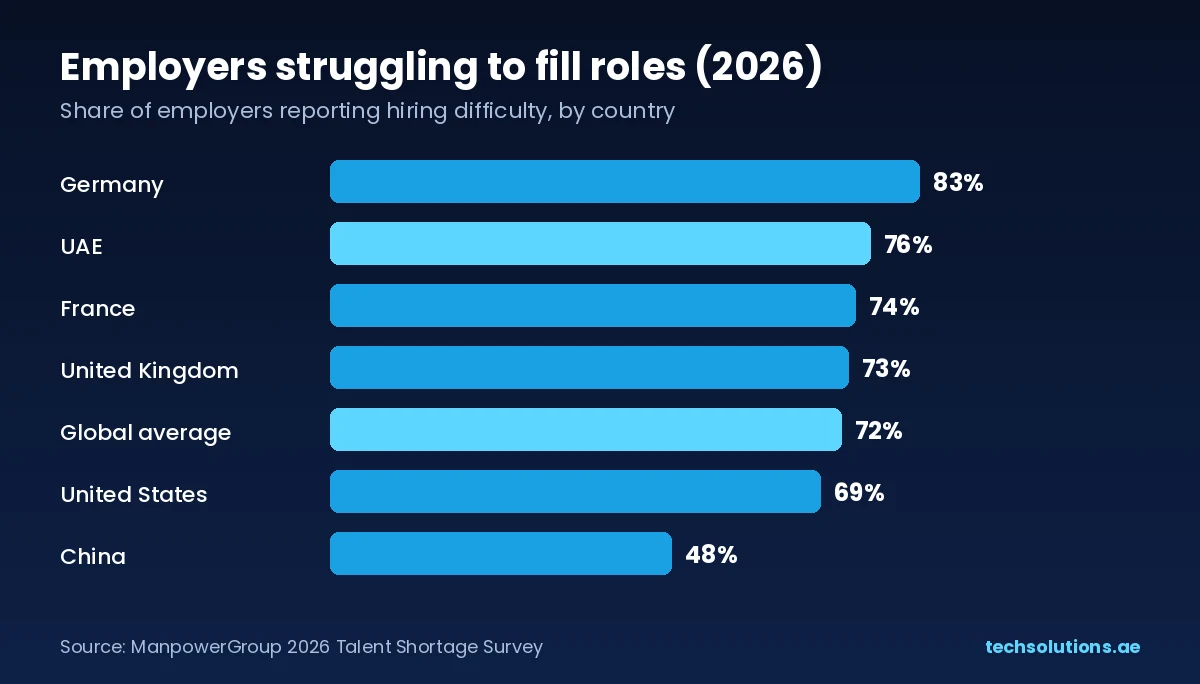
Hiring difficulty by country
| Country | Employers struggling to fill roles |
|---|---|
| Germany | 83% |
| UAE | 76% |
| France | 74% |
| United Kingdom | 73% |
| Global average | 72% |
| United States | 69% |
| China | 48% |
Source: ManpowerGroup 2026 Talent Shortage Survey; UAE figure as reported by People Matters.
What tech leaders say
The Reveal 2026 IT Talent Survey of 250 senior technology leaders found:
- 91% say hiring people with AI skills is a priority for 2026, up from 89% in 2025.
- Only 7% report no hiring difficulties at all.
- AI engineers (39%) are the hardest role to fill, followed by cybersecurity engineers (38%).
- Python (56%) and AI/machine learning (47%) are the most in-demand skills.
Why the AI skills gap keeps growing
The gap widens because demand for AI skills is growing several times faster than new talent can be trained.
1. Demand is growing much faster than supply
PwC’s 2026 Global AI Jobs Barometer analysed more than one billion job ads across 27 countries. Jobs requiring specific AI skills grew 69%, against 9% for the job market overall. The number of AI jobs has almost doubled since 2024.
2. Everyone wants senior talent
About 70% of tech leaders in the Reveal survey prioritise senior technical staff, and only 12% plan to focus on entry-level hires. When every company chases the same small pool of experienced AI engineers, the shortage gets worse rather than better.
3. Salaries are rising fast
Workers with AI skills now earn a 62% wage premium on average, up from 57% a year earlier (PwC, 2026). Smaller companies and non-tech firms find it hard to compete with big tech budgets.
4. The skills themselves keep changing
In the UAE, PwC found that AI-exposed roles require an average of 77 new skills, against 22 in the least exposed roles (PwC UAE, 2026). University courses and training programmes struggle to keep up with tools that change every few months.
5. Entry-level roles now need senior skills
PwC found that entry-level roles most exposed to AI are seven times more likely to require skills traditionally expected of senior staff. The usual route from junior to senior is getting harder, which shrinks the future talent pipeline.
The hardest AI roles to fill in 2026
The hardest roles combine AI knowledge with deep engineering experience, which is the rarest mix in the market.
| Role | What they do | Key skills |
|---|---|---|
| AI / ML engineer | Builds, trains and deploys machine learning models in production | Python, PyTorch or TensorFlow, MLOps |
| LLM application developer | Builds products on large language models: chatbots, copilots, AI agents | LLM APIs, RAG, prompt design, evaluation |
| MLOps / AI platform engineer | Runs the infrastructure that serves and monitors models | Kubernetes, cloud, model serving, monitoring |
| Data engineer | Builds the data pipelines AI depends on | SQL, Spark, data warehouses, data quality |
| AI security engineer | Protects AI systems from data leaks, misuse and attacks | Cybersecurity, cloud security, AI risk |
| AI product manager | Turns business problems into AI products that people actually use | AI literacy, product strategy, evaluation |
The roles that support AI are scarce too. Reveal’s survey ranks cybersecurity engineers (38%) and cloud engineers (25%) close behind AI engineers as the hardest to hire.
What the AI skills gap costs your business
Leaving AI roles empty costs more than the salary you save: you also fall behind competitors who are already using AI.
- Lost productivity: PwC found that the most AI-exposed industries saw 34% productivity growth between 2018 and 2025, against 24% for the least exposed. Companies without AI talent miss that gain.
- Slower growth: at the most AI-exposed companies, headcount grew 52% and wages grew 24%, compared with 36% and 17% at the least exposed. AI adoption is linked to business growth, not job cuts.
- Delayed projects: AI budgets are approved, but projects stall while roles stay open for months.
- Higher hiring costs: a 62% wage premium, plus recruiter fees and long vacancies, makes each permanent AI hire expensive.
- Risky shortcuts: teams without AI expertise may deploy tools without proper security, testing or governance.
6 ways to close the AI skills gap
No single fix is enough. The companies doing best combine long-term upskilling with fast access to specialists. ManpowerGroup found that 91% of employers already use a mix of strategies.
| Strategy | Time to impact | Best for |
|---|---|---|
| 1. Upskill your current team | 6–12 months | Building AI literacy across the company |
| 2. AI staff augmentation | 2–6 weeks | Specialist roles and urgent projects |
| 3. Hire from global talent pools | 1–3 months | Long-term roles where location doesn’t matter |
| 4. Hire for potential, then train | 6+ months | Building a future pipeline |
| 5. Use AI tools to boost existing staff | Weeks | Raising the output of teams you already have |
| 6. Partner for a defined AI project | 1–2 months | One-off builds such as a chatbot or pilot |
1. Upskill your current team
Upskilling and reskilling is the most common response, used by 27% of employers (ManpowerGroup). Start with AI literacy for everyone, then deeper training for engineers who already know your systems.
2. Use AI staff augmentation
AI staff augmentation means adding vetted AI engineers to your own team for as long as a project needs them. You get senior skills in weeks instead of months, with no long-term salary commitment. Your augmented engineers can also mentor your in-house staff, so the skills stay after they leave. For models, costs and a partner checklist, see our IT staff augmentation guide for 2026.
3. Look beyond your local market
Eighteen percent of employers are already targeting new talent pools, and 18% offer location flexibility (ManpowerGroup). Remote and offshore engineers widen your options, especially for teams in high-shortage markets such as the UAE, UK and Germany.
4. Hire for potential, then train
Strong software engineers with good fundamentals can learn AI tools quickly. Pair them with senior AI specialists, whether permanent or augmented, so they learn on real projects.
5. Give your team AI tools
Eighty percent of tech leaders already use AI in software development (Reveal). AI coding assistants and automation tools let your current engineers deliver more while you build AI capability.
6. Partner for a defined project
If the need is a single, well-scoped build, such as an internal chatbot or a document-processing pilot, a project partner can deliver it end to end. This works best when you don’t need to keep the skills in-house.
How Tech Solutions helps you close the AI skills gap
Tech Solutions (techsolutions.ae) provides AI and software engineers through IT staff augmentation. You get the AI skills you need in weeks, without a long hiring process.
Tech Solutions is headquartered in the Sharjah Research Technology and Innovation Park (SRTIP) Free Zone, with offices in the UK, the US and Pakistan. Its engineers have worked with teams at QPharma, GSK, Regeneron, P&G, Nestlé and Ciklum.
How we help:
- AI and data engineers on demand: Python, machine learning, LLM application, data and cloud engineers who join your team under your management.
- Flexible engagement models: contract, contract-to-hire, project-based or a dedicated team.
- Knowledge transfer built in: our engineers document their work and pair with your staff, so the capability stays after the engagement.
- Time zone fit: teams across the UAE and Pakistan, with working-hour overlap for UK, European and US clients.
- Compliance handled: sourcing, contracts, payroll and local employment rules.
Need AI talent now? Explore our IT staff augmentation services or share your job description to receive matched AI engineer profiles.
Frequently asked questions about the AI skills gap
What is the AI skills gap?
The AI skills gap is the shortfall between the AI skills employers need and the talent available to hire. In 2026, AI model and application development and AI literacy became the hardest skills to find worldwide, according to ManpowerGroup’s survey of 39,000 employers.
How big is the AI skills gap in 2026?
The gap is large and global. 72% of employers worldwide report difficulty filling roles, rising to 76% in the UAE and 83% in Germany. PwC found that jobs requiring AI skills grew 69% while the overall job market grew 9%.
Which AI jobs are hardest to fill?
AI engineers are the hardest tech role to fill, cited by 39% of tech leaders in the Reveal 2026 survey. LLM application developers, MLOps engineers, data engineers and AI security specialists are also in short supply.
How much more do AI-skilled workers earn?
Workers with AI skills earn a 62% wage premium on average, up from 57% the previous year, according to PwC’s 2026 Global AI Jobs Barometer. The premium varies widely by sector.
How can companies close the AI skills gap quickly?
The fastest route is AI staff augmentation, which adds vetted AI engineers to your team within weeks. For long-term results, combine it with upskilling your current team and hiring for potential.
Is the AI skills gap a problem in the UAE?
Yes. 76% of UAE employers report difficulty hiring, above the global average. PwC also reports that the share of UAE job postings requiring AI skills roughly tripled between 2021 and 2025.
Can Tech Solutions provide AI engineers?
Yes. Tech Solutions (techsolutions.ae) provides AI, data, cloud and software engineers through IT staff augmentation. It serves clients in the UAE, GCC, UK, Europe and the US.
